Understanding seasonal production cycles is one of the most important factors in successful perishables logistics. Every year, exporters, importers, distributors, and retailers must prepare for fluctuations in harvest volumes, transportation demand, cold storage utilization, and market availability. A well-planned logistics strategy starts with visibility into seasonal production patterns, which is why the produce export calendar has become an essential planning tool for businesses operating in the global perishables industry.
Latin America remains one of the world’s most important suppliers of fresh fruits, vegetables, seafood, flowers, and specialty agricultural products. Countries such as Ecuador, Colombia, Peru, Chile, Argentina, Guatemala, and the Dominican Republic supply millions of tons of products to international markets every year. These products move through complex supply chains that require careful coordination, advanced cold chain infrastructure, and precise transportation planning.
Businesses that understand seasonal export cycles are better positioned to secure transportation capacity, reduce spoilage, improve inventory management, and maintain customer satisfaction. Many organizations begin this process by implementing the strategies discussed in our blog Export Seasons in Latin America, which highlights the importance of aligning logistics operations with agricultural production cycles.
2026 LCX Fresh Produce Export Calendar
📅 Bookmark This Resource
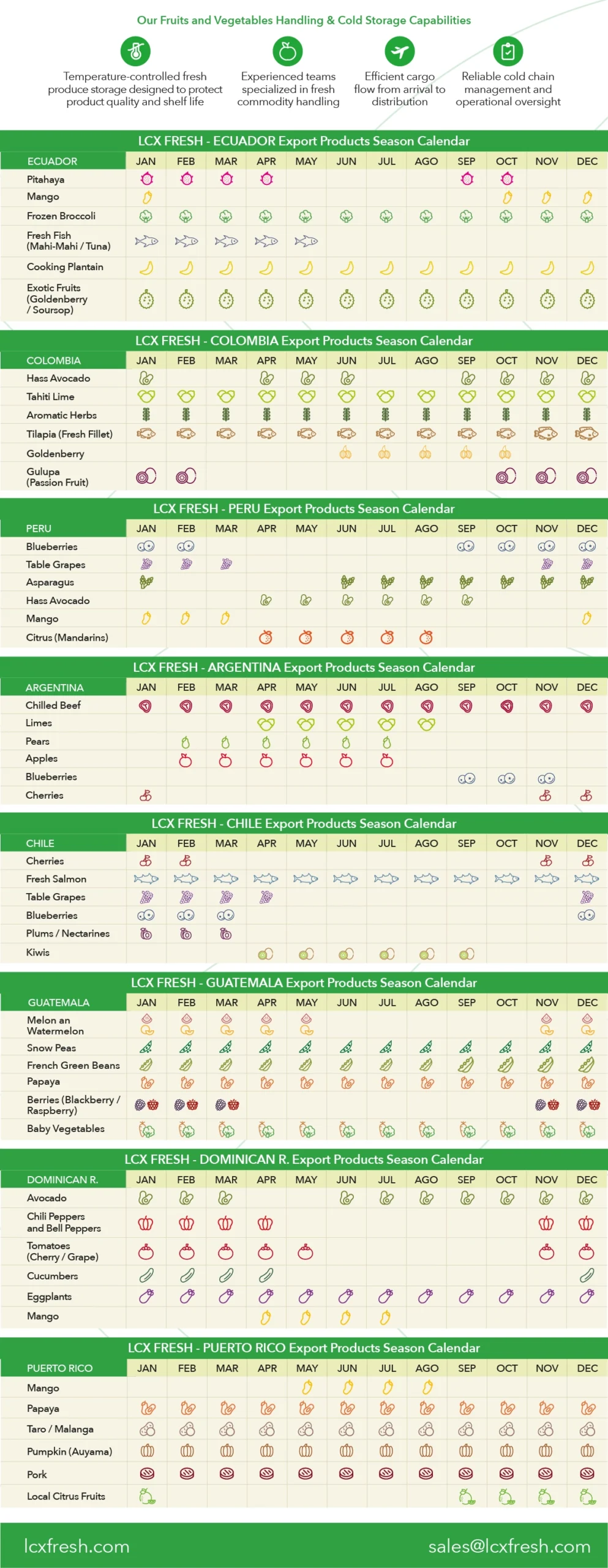
The LCX Fresh Produce Export Calendar is updated annually to help importers, exporters, distributors, retailers, and logistics providers anticipate seasonal demand, optimize transportation planning, and improve cold chain performance across Latin America.
Save this page for future reference and revisit it throughout the year as production cycles shift across major export markets.
The image above provides a visual overview of major export seasons throughout Latin America. While exact production schedules can vary based on weather conditions and agricultural trends, the calendar serves as a valuable resource for forecasting transportation demand and preparing supply chains for seasonal fluctuations.
The produce export calendar can help businesses:
- Forecast transportation requirements
- Secure warehouse capacity
- Improve inventory planning
- Reduce product loss
- Optimize distribution strategies
- Improve customer service levels
Organizations that proactively prepare for seasonal changes often achieve stronger operational performance throughout the year.
Why Export Seasons Matter
Agricultural products rarely move in consistent volumes throughout the year. Most perishables experience seasonal production peaks that create temporary increases in transportation demand.
During peak export periods, businesses may encounter:
- Limited air cargo capacity
- Increased trucking demand
- Higher warehouse utilization
- Greater customs processing volumes
- More competition for refrigerated equipment
These challenges make planning essential.
Companies looking to reduce product loss during seasonal surges frequently implement best practices outlined in Reducing Spoilage Through Better Temperature-Controlled Logistics, where maintaining environmental stability becomes a critical factor in preserving freshness and extending shelf life.
As global demand continues to increase, the ability to align logistics operations with the produce export calendar is becoming a major competitive advantage.
Ecuador Export Seasons
Ecuador remains one of the most diversified agricultural exporters in Latin America. The country supplies pitahaya, mangoes, plantains, frozen broccoli, exotic fruits, flowers, and fresh tuna to international markets throughout much of the year.
Many of these products require specialized handling procedures due to strict temperature requirements. Fresh tuna, tropical fruits, and floral products must maintain consistent environmental conditions throughout transportation to protect quality and market value.
For exporters handling multiple product categories simultaneously, strategies similar to those explored in From Flowers to Seafood: Managing Temperature-Controlled Cargo Across Latin America’s Export Calendar help improve coordination and reduce operational complexity.
Ecuador’s strong air cargo connectivity and proximity to major trade routes make it one of the most important contributors to regional perishables logistics.
Colombia Export Seasons
Colombia has emerged as a major exporter of Hass avocados, Tahiti limes, passion fruit, goldenberries, aromatic herbs, and tilapia.
The country’s diverse climate supports year-round production across multiple agricultural categories, creating unique opportunities for exporters and importers alike.
As volumes continue to increase, organizations are investing in scalable logistics systems capable of adapting to changing market conditions. Many companies apply lessons from Scaling Fresh Logistics Networks for Global Demand to improve flexibility while supporting growth across multiple regions.
The ability to scale transportation and warehousing resources efficiently is becoming increasingly important as Colombian exports continue expanding into international markets.
Peru Export Seasons
Peru has become one of the most influential players in global produce exports. Blueberries, grapes, avocados, citrus products, asparagus, and mangoes represent some of the country’s most important agricultural categories.
Peru’s blueberry season in particular generates substantial demand for refrigerated transportation and cold storage infrastructure.
Because of seasonal peaks, exporters rely on Cold Chain Management to maintain product quality during transport.
The rapid growth of Peru’s agricultural exports demonstrates how strategic logistics investments can support long-term competitiveness within global markets.
Argentina Export Seasons
Argentina remains a leading exporter of pears, apples, cherries, blueberries, citrus products, and premium beef.
Many of these products serve high-value international markets where freshness and delivery reliability directly impact profitability.
As transit times become increasingly important, many exporters depend on the transportation strategies outlined in Why Air Cargo Matters for High-Value Perishables Logistics to reduce delays and improve market access.
Air transportation can significantly extend product shelf life while helping businesses meet strict delivery schedules in competitive international markets.
Chile Export Seasons
Chile continues to dominate several key export categories including cherries, salmon, blueberries, kiwis, grapes, and stone fruits.
The country’s salmon industry depends on an efficient cold chain because its products are highly perishable.
Many operational best practices used in Chilean seafood exports closely resemble those discussed in California Perishables Logistics: Handling Seafood and Fresh Cargo with Precision, where maintaining temperature consistency throughout transportation remains a top priority.
As demand for premium seafood products continues to grow, logistics providers must continue investing in infrastructure capable of supporting larger export volumes without compromising product quality.
Guatemala and Dominican Republic Export Seasons
Guatemala and the Dominican Republic contribute significantly to regional exports through products such as melons, papayas, mangoes, avocados, peppers, cucumbers, green beans, snow peas, and tomatoes.
Efficient warehousing and distribution networks are critical, as these products move through multiple transportation modes.
Organizations often implement recommendations similar to those found in Strategic Warehouse Locations: How LCX Fresh Supports Cold Chain Logistics Across Key U.S. Markets to position inventory closer to key transportation hubs and consumer markets.
This approach improves responsiveness while reducing transportation times and maintaining product freshness.
Supporting Seasonal Demand Through Cold Storage
As export volumes increase throughout the year, transportation capacity alone is not enough to maintain supply chain performance. Effective cold storage infrastructure plays a critical role in ensuring products remain within required temperature ranges while awaiting transportation or final distribution.
Organizations that align operations with the produce export calendar often experience improved inventory management and reduced spoilage because they can anticipate warehouse requirements before seasonal peaks occur.
Modern businesses increasingly implement strategies discussed in Cold Storage and Distribution Strategies for Perishables Logistics to improve inventory flow, maximize throughput, and maintain product quality during periods of high demand.
Explore LCX Fresh infrastructure through:
- Cold Chain Management
- Cold Storage Facilities
- Warehouse Locations
Strategically positioned facilities allow products to move rapidly between transportation modes while maintaining temperature integrity. This becomes especially important when handling products such as seafood, berries, flowers, pharmaceuticals, and premium food products that require continuous environmental control.
As global agricultural exports continue growing, cold storage capacity will remain one of the most important components supporting the produce export calendar.
Technology Is Transforming Produce Logistics
Technology continues to reshape how perishables move across international markets.
Modern supply chains increasingly rely on:
- IoT temperature sensors
- GPS shipment tracking
- Predictive analytics
- Artificial intelligence
- Warehouse automation
- Real-time visibility platforms
These tools provide greater control over temperature-sensitive shipments while helping businesses respond quickly to disruptions.
Companies investing in digital transformation often follow principles similar to those outlined in Technology in Fresh Logistics, where data-driven decision making helps improve visibility and operational performance.
According to GS1, traceability remains one of the most important priorities for modern supply chains.
https://www.gs1.org/standards/traceability
As exports and expectations grow, technology is key to an efficient cold chain.
Maintaining Compliance Across International Supply Chains
Perishables logistics requires strict adherence to quality standards throughout transportation and storage operations.
Food safety regulations, customer requirements, and international trade standards all influence how products are handled.
Organizations that consistently achieve high service levels often implement the best practices discussed in Cold Chain Compliance: Ensuring Quality and Safety in Perishable Logistics.
Compliance programs help support:
- Product quality
- Food safety
- Regulatory adherence
- Customer satisfaction
- Supply chain transparency
For companies operating across multiple countries, maintaining compliance becomes increasingly important as products move through complex international networks.
The organizations best positioned for long-term success are those that integrate compliance into every stage of their logistics operations.
Managing Risk During Peak Export Seasons
Seasonal demand creates opportunities, but it also introduces challenges.
Common risks include:
- Weather disruptions
- Capacity shortages
- Equipment failures
- Transportation delays
- Customs bottlenecks
- Temperature deviations
Businesses that proactively prepare for these challenges typically experience stronger operational performance.
Many organizations implement recommendations from Cold Chain Risk Management for Perishable Supply Chains to improve resilience and minimize disruptions during peak harvest periods.
Risk management helps businesses maintain service continuity while protecting product quality and customer relationships.
As demand continues to increase, organizations that successfully manage risk will gain a significant competitive advantage.
Miami: The Primary Gateway to North America
For many exporters throughout Latin America, Miami serves as the most important entry point into North American markets.
Its strategic location, extensive air cargo connectivity, refrigerated warehousing infrastructure, and distribution capabilities make it one of the world’s leading perishables logistics hubs.
Many fresh products moving through the produce export calendar ultimately pass through systems similar to those discussed in Miami Cold Chain Hub: End-to-End Perishable Logistics for Global Trade.
Miami supports:
- Air cargo operations
- Refrigerated warehousing
- Customs processing
- Distribution services
- Cross-docking operations
These capabilities help reduce transit times while improving product quality and market access.
The city’s cold chain role will expand as trade volumes in the Americas increase.
The Importance of Flower Logistics
While fruits and vegetables dominate many export discussions, flowers remain one of Latin America’s most valuable perishables categories.
Fresh flower exports require:
- Rapid transportation
- Precise temperature control
- Specialized packaging
- Efficient distribution
Many of the same principles used throughout New York Flower Logistics: Moving Fresh Blooms and Perishables Efficiently are also applicable to international flower supply chains originating in Ecuador and Colombia.
As consumer demand for fresh flowers continues growing, logistics providers must maintain reliable transportation networks capable of preserving product quality throughout every stage of the journey.
Future Trends Shaping the Produce Export Calendar
Several important trends are expected to influence agricultural exports throughout the coming years.
Greater Demand for Fresh Products
Consumers increasingly prefer fresh fruits, vegetables, seafood, and specialty foods, creating new opportunities for exporters.
Increased Use of Air Cargo
As high-value perishables become more common, transportation models similar to those discussed in Why Air Cargo Matters for High-Value Perishables Logistics will continue expanding.
Stronger Logistics Networks
Businesses will keep investing in scalable infrastructure to meet growing global demand.
More Strategic Warehousing
Warehouse placement will become an even more important competitive advantage.
Better Visibility Through Technology
Real-time monitoring and predictive analytics will improve transparency and operational efficiency across the supply chain.
These trends reinforce the importance of understanding and utilizing the produce export calendar when planning future logistics operations.
What Exporters Can Do Today
Businesses preparing for future growth should focus on:
- Forecasting seasonal demand
- Securing transportation capacity early
- Expanding cold storage access
- Improving visibility and monitoring
- Strengthening supplier relationships
- Developing contingency plans
Organizations that invest in proactive planning often achieve greater efficiency and stronger long-term performance.
The ability to anticipate seasonal changes remains one of the most valuable advantages within perishables logistics.
Frequently Asked Questions
What is a produce export calendar?
A produce export calendar identifies seasonal harvest and export periods for agricultural products, helping businesses forecast transportation, warehousing, and distribution requirements.
Why is the produce export calendar important?
The produce export calendar helps organizations improve planning, secure transportation capacity, reduce spoilage risk, and optimize supply chain performance.
Which country exports the most blueberries in Latin America?
Peru is one of the region’s leading blueberry exporters and continues expanding production to meet growing international demand.
Why do export seasons affect logistics costs?
Peak harvest periods often increase demand for transportation and cold storage resources, which can influence pricing and service availability.
How does cold chain logistics support agricultural exports?
Cold chain logistics maintains product quality through temperature-controlled transportation, storage, monitoring, and distribution.
Why is Miami important for perishables logistics?
Miami serves as a major gateway connecting Latin American exporters with North American consumer markets through advanced cold chain infrastructure.
What role does technology play in produce exports?
Technology improves visibility, traceability, forecasting, monitoring, and overall supply chain performance.
How can businesses prepare for peak export seasons?
Organizations should forecast demand, secure capacity early, strengthen cold chain infrastructure, and invest in scalable logistics solutions.
Conclusion
The produce export calendar provides a valuable framework for understanding seasonal agricultural production across Latin America’s most important exporting countries. From Ecuador’s tropical fruits and Colombia’s avocados to Peru’s blueberries and Chile’s salmon, export seasons influence every aspect of perishables logistics.
Organizations that proactively align operations with seasonal production cycles are better positioned to optimize transportation capacity, improve inventory management, and maintain product quality throughout the supply chain.
Businesses that implement strategies from Reducing Spoilage Through Better Temperature-Controlled Logistics, strengthen operations through Scaling Fresh Logistics Networks for Global Demand, improve infrastructure with Strategic Warehouse Locations: How LCX Fresh Supports Cold Chain Logistics Across Key U.S. Markets, and maintain visibility through Technology in Fresh Logistics will be better prepared to meet future demand.
As global trade continues to evolve, organizations that understand and leverage the produce export calendar will be best positioned to build resilient supply chains, reduce spoilage, improve service levels, and capitalize on new opportunities across international perishables markets.